
Planning a Kenya or Tanzania safari in 2026? Then you have almost certainly seen the Ebola travel update 2026 making headlines. A new outbreak, caused by the Bundibugyo strain, has prompted the World Health Organization to declare a global public health emergency. Understandably, therefore, many travelers are asking questions. This guide gives you the facts — clearly, calmly, and based entirely on verified sources — so you can make a confident, informed decision about your safari.
<p class=”font-claude-response-body break-words whitespace-normal leading-[1.7]”>On 17 May 2026, the World Health Organization declared the Ebola virus disease outbreak caused by the Bundibugyo virus in the Democratic Republic of the Congo and Uganda a Public Health Emergency of International Concern. European Centre for Disease Prevention and Control
This is, in fact, a significant designation. However, it is important to understand exactly what it means — and, furthermore, what it does not mean — for safari travelers heading to East Africa.
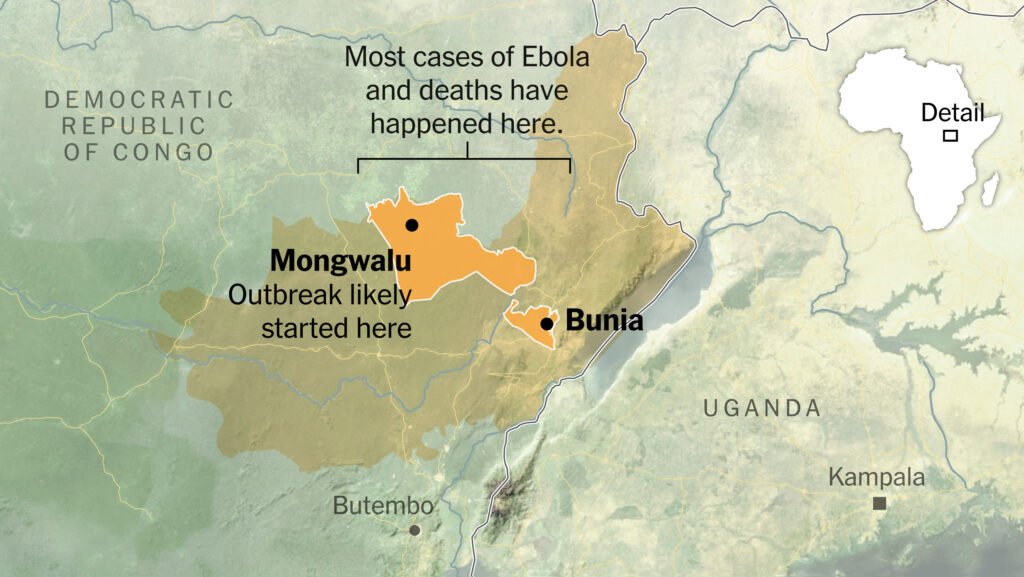
The outbreak was first confirmed on 15 May 2026 in Ituri Province in northeastern DRC. As of mid-May, a total of 246 suspected cases and 80 deaths had been reported. CDC
Numbers have since risen as the outbreak has developed. As of 21 May 2026, at least 139 people had been killed across DRC and Uganda, with more than 600 suspected cases reported. The EastAfrican
So, is this Ebola travel update 2026 a direct crisis for safari travelers in Kenya and Tanzania? The honest answer is: not currently. However, it does require careful attention and up-to-date information from every traveler planning a trip to the region.
Understanding the geography is, in fact, the single most important step for any safari traveler right now.
As of 24 May 2026, the Ebola Bundibugyo outbreak in DRC has been confirmed in Ituri, Nord-Kivu, and Sud-Kivu provinces. Furthermore, five cases related to the DRC outbreak have also been reported in Uganda’s capital of Kampala. CDC
On 15 May 2026, CDC issued a Level 1 Travel Health Notice for people traveling to Uganda and a Level 3 Travel Health Notice for people traveling to DRC. CDC
These are the two countries where active transmission is currently occurring. Kenya, Tanzania, Rwanda, and other popular safari destinations have, therefore, reported no confirmed cases linked to this outbreak. The distance between the outbreak epicentre in eastern DRC and Nairobi, Kenya is comparable to the distance between London and Moscow. Context, therefore, matters enormously.
s=”font-claude-response-body break-words whitespace-normal leading-[1.7]”>Kenya is not currently experiencing an Ebola outbreak. However, the country has taken precautionary action in response to the regional situation.
Kenya said it had heightened screening of travellers, though there was no testing of suspected cases at the crossings. The EastAfrican
The U.S. Embassy in Kenya updated the country’s travel advisory to Level 2: Exercise Increased Caution, updated to include a risk indicator for health. U.S. Embassy in Kenya
Importantly, this Level 2 advisory reflects a general precautionary posture. It is not, therefore, a recommendation to avoid Kenya altogether. Moreover, there is no entry ban or evacuation order in place at this time. As a result, safari travel to Kenya’s major parks — including Masai Mara, Amboseli, Samburu, and Tsavo — continues without restriction.
If you are flying directly to Kenya from Europe, North America, or Asia, your arrival experience will include standard temperature checks. Furthermore, if you have transited through DRC or Uganda within the previous 21 days, you will be required to complete an additional health declaration form. For most international safari travelers, however, these measures will have minimal impact on their journey.
Tanzania similarly has no confirmed Ebola cases. Nevertheless, the country has introduced proportionate entry health measures in response to the regional Ebola travel update 2026.
Due to outbreaks of Ebola disease in DRC and Uganda, all travellers arriving from or transiting through these countries are subject to health screening measures at points of entry. These include the completion of a health declaration form and temperature checks. Travel.gc.ca
Due to the outbreak of Ebola disease in Central Africa, travellers must undertake health screening and body temperature checks on arrival in Tanzania. If arriving from DRC or Uganda, a Traveller’s Surveillance Form must also be completed. Smartraveller
These are standard, proportionate public health responses. They apply specifically to travellers arriving from outbreak zones, not to general international visitors. Therefore, a safari traveller flying directly to Tanzania from elsewhere will face routine checks only.
Tanzania’s iconic safari destinations — including Serengeti National Park, Ngorongoro Conservation Area, and Tarangire National Park — remain fully open. Furthermore, no park closures or movement restrictions have been announced. Tour operators based in Tanzania are monitoring the situation daily and continue to welcome international guests as normal.
The head of Africa CDC listed 10 countries considered at risk in the current outbreak: Angola, Burundi, the Central African Republic, the Republic of Congo, Ethiopia, Kenya, Rwanda, South Sudan, Tanzania, and Zambia. Al Jazeera
It is vital, therefore, to understand what “at risk” means in this context. These countries have not reported confirmed cases. Rather, they are flagged for enhanced monitoring because of geographic proximity or travel links with affected regions. Being listed as “at risk” is, in other words, a preparedness designation — not a health warning for travelers.
The response to this Ebola travel update 2026 has been fast and coordinated at the highest levels.
Africa CDC declared a Public Health Emergency of Continental Security on 18 May 2026. European Centre for Disease Prevention and Control
On 18 May 2026, CDC and DHS announced enhanced travel screening, entry restrictions, and public health measures to prevent Ebola disease from entering the United States. CDC
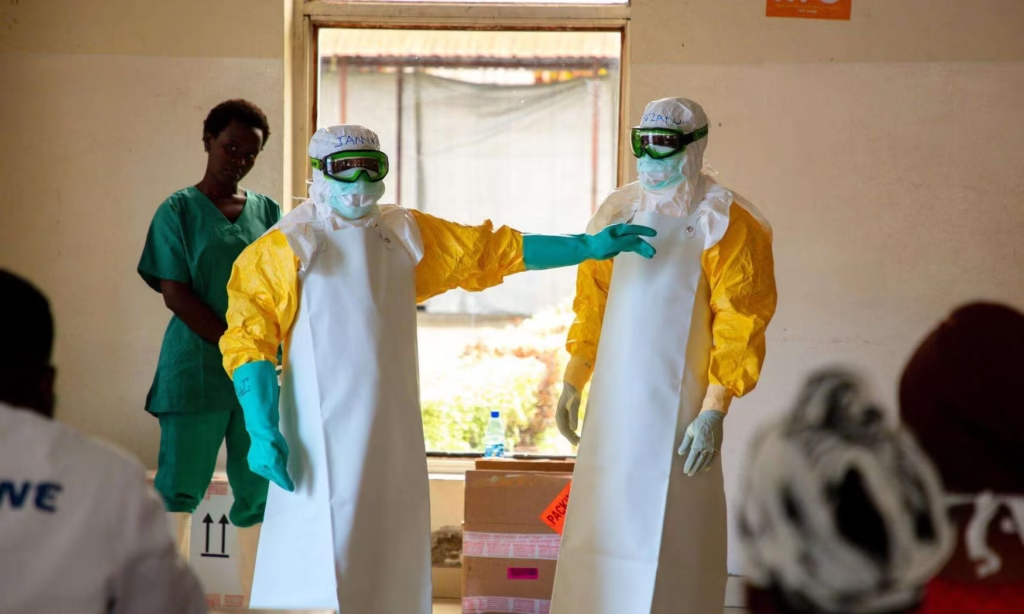
CDC has extensive experience and some of the world’s foremost experts in supporting Ebola response operations in the region and remains committed to protecting global health security. Field teams are, furthermore, already active across DRC and Uganda, with contact tracing underway for all known cases. CDC
Reputable safari operators have been proactive in communicating with clients about the current Ebola travel update 2026.
Shaun Stanley, founder and managing director of Stanley Safaris, sent a letter to guests assuring those going to Rwanda, Tanzania, or Kenya that “the situation has no bearing on your trip.” He added: “Africa is not a single place, and an outbreak in a remote province of the DRC is no more a reason to cancel a gorilla trek in Rwanda than an outbreak in one part of Europe would be a reason to cancel a trip to another. Context is everything.” Travel Weekly
Travel advisors are spending significant time with clients on geography. The DRC and the affected areas of Uganda are thousands of miles from where most travellers are going: Rwanda, Kenya, Tanzania, and Botswana — entirely separate regions. Travel Weekly
This perspective is not only reassuring — it is factually accurate. However, it does not mean travelers should ignore the situation entirely. Instead, staying informed and booking with experienced operators is, therefore, the most sensible approach.
Understanding the basics of Ebola is important for every traveler in the region right now. Ebola virus spreads through direct contact with the bodily fluids of an infected person and does not spread through casual contact or air. CDC
Symptoms typically appear between 2 and 21 days after exposure. Key symptoms to be aware of include:
If you develop any of these symptoms within 21 days of travelling through DRC, Uganda, or South Sudan, seek medical attention immediately. Furthermore, always inform your healthcare provider of your recent travel history so they can respond appropriately.
The Bundibugyo species of Ebola virus was first identified in Uganda in 2007 and has historically been associated with somewhat lower case fatality rates than other species of Ebola virus disease, though severe disease and death can still occur. CDC
One key concern, furthermore, is that the Bundibugyo variant currently lacks any authorised vaccine or targeted therapy. This makes containment more challenging than in previous outbreaks involving the Zaire strain. However, for safari travellers not in contact with affected communities in DRC or Uganda, the personal risk remains very low. Tourism Review
Given the current Ebola travel update 2026, here is a clear action plan for anyone planning a Kenya or Tanzania safari:
This is a real and legitimate concern. Historically, Ebola outbreaks in one part of Africa have caused booking cancellations across the entire continent — even in destinations thousands of kilometres away. However, informed travellers who understand the geography and follow official guidance are in a strong position to make rational, evidence-based decisions.
For now, therefore, the peak safari season in Kenya and Tanzania is proceeding normally. Camps and lodges remain open, game drives are continuing, and no restrictions on wildlife tourism have been announced in either country.
Given that the situation is evolving daily, bookmark these reliable sources:
Q1. Is there an Ebola outbreak in Kenya in 2026? No. As of May 2026, Kenya has no confirmed Ebola cases. The outbreak is centred in DRC and Uganda. Kenya has, however, introduced health screening at entry points as a precautionary measure.
Q2. Is Tanzania safe to visit during the 2026 Ebola outbreak? Yes. Tanzania has no confirmed cases. The country has introduced temperature checks and health declaration forms for travellers arriving from DRC and Uganda. General safari travel continues normally.
Q3. Which countries have confirmed Ebola cases in 2026? As of late May 2026, confirmed cases have been reported in DRC and Uganda only. Ten other countries, including Kenya and Tanzania, are listed as “at risk” for monitoring purposes but have reported no confirmed cases.
Q4. Can I still go on safari in Kenya or Tanzania in 2026? Yes. Both countries remain open to international visitors. Safari parks are fully operational and no travel bans are in place for either destination.
Q5. What is the Bundibugyo Ebola strain? The Bundibugyo strain is a species of Ebola virus first identified in Uganda in 2007. It generally has a lower case fatality rate than the Zaire strain but remains serious. No approved vaccine currently exists for this strain.
Q6. How does Ebola spread? Ebola spreads through direct contact with the bodily fluids of an infected person. It does not spread through casual contact, air, water, or food. The personal risk to safari travellers is therefore very low.
Q7. What should I do if I develop symptoms after visiting East Africa? Seek medical attention immediately and inform your healthcare provider of your recent travel history. Key symptoms include fever, fatigue, muscle pain, vomiting, and diarrhoea, appearing between 2 and 21 days after exposure.
Q8. Has WHO declared Ebola a pandemic in 2026? No. WHO has declared a Public Health Emergency of International Concern. However, the committee confirmed it does not currently meet the criteria for a pandemic emergency.
Q9. Are safari lodges and camps in Kenya and Tanzania still open? Yes. All major safari lodges, camps, and national parks in Kenya and Tanzania are open and fully operational. There are no closures related to the Ebola outbreak in either country.
Q10. Should I cancel my Kenya or Tanzania safari because of Ebola? Based on current official guidance, there is no recommendation to cancel travel to Kenya or Tanzania. Monitor official advisories, stay in contact with your operator, and base decisions on verified information rather than media headlines.
Q11. Is travel insurance affected by the Ebola outbreak? Some insurers may update their policies in response to a declared public health emergency. Therefore, contact your travel insurer directly to confirm your coverage, particularly for medical evacuation.
Q12. Where is the 2026 Ebola outbreak located in Africa? The outbreak is concentrated in Ituri, Nord-Kivu, and Sud-Kivu provinces of eastern DRC, and has spread to Kampala in Uganda. It has not reached Kenya, Tanzania, Rwanda, Botswana, or southern Africa.
The facts from this Ebola travel update 2026 are clear. Kenya and Tanzania have no confirmed Ebola cases. Safari parks are open. Wildlife is moving. And the experience of a lifetime has not changed.
What has changed, however, is the importance of booking with a trusted, experienced safari operator — one who monitors the situation daily, communicates transparently with clients, and adapts itineraries when needed.
If you have questions about how the current situation affects your planned safari, get in touch with our team today. We will give you honest, up-to-date information and help you plan with complete confidence.