
Planning an African safari and stuck choosing between the Masai Mara in Kenya and the Serengeti in Tanzania? You are not alone. This is, by far, the most common question we receive at WeGuide African Safaris, and after 11 years of guiding clients through both parks, we have a clear, honest answer for you.
Together, the Masai Mara and the Serengeti form one continuous, unfenced ecosystem that hosts the Great Wildebeest Migration — the greatest wildlife spectacle on earth. However, despite sharing the same herds and the same border, these two African safari destinations are strikingly different in size, cost, crowd levels, and the experience they deliver.
In this guide, we break down every key difference so that by the end, you will know exactly which park is right for your trip, your budget, and your travel dates. Whether you are a first-time safari traveller or a seasoned Africa explorer, this is the comparison you need before you book.
View Masai Mara Safaris
View Serengeti Safaris
Before diving into the detail, here is a side-by-side snapshot of the two most iconic African safari destinations in East Africa.
| Feature | Masai Mara — Kenya | Serengeti — Tanzania |
|---|---|---|
| Park Size | 1,510 sq km | 14,760 sq km (10x larger) |
| Great Migration | July to October (3 months) | Year-round across different zones |
| Mara River Crossings | August to September (peak) | Northern Serengeti, July to October |
| Calving Season | Not applicable | January to March in Ndutu |
| Wildlife Density | Very high, concentrated | Spread across vast terrain |
| Vehicle Crowds | Higher during peak season | Lower — more wilderness feel |
| Off-Road Driving | Permitted in conservancies | Strictly prohibited |
| Safari Cost | More budget-friendly | Generally more expensive |
| Nearest Airport | Nairobi (1 hr flight or 5-6 hr drive) | Kilimanjaro or Arusha — internal flight |
| Multi-Park Circuit | Amboseli, Nakuru, Samburu | Ngorongoro, Tarangire, Manyara |
| Minimum Trip Length | 3 to 5 days | 5 to 7 days |
| Best For | First-timers, shorter trips, budget travelers | Wilderness, year-round migration, solitude |
When comparing the Masai Mara vs the Serengeti, the most immediate difference is physical size — and this single factor shapes everything else about your African safari experience.
The Serengeti National Park in Tanzania covers approximately 14,760 square kilometres, making it one of the largest and most celebrated wildlife reserves on earth. Its name derives from the Maasai word Siringet, meaning “endless plains,” and that description holds true the moment you arrive. Across the central Seronera grasslands or the southern Ndutu plains, the horizon stretches so far that the scale feels almost incomprehensible. Moreover, because the Serengeti is so vast, you can drive for an hour tracking lions across open savannah without encountering another vehicle. That rare sensation — of being genuinely alone inside a living wilderness — is what defines a Serengeti safari and keeps experienced travelers returning to Tanzania year after year.
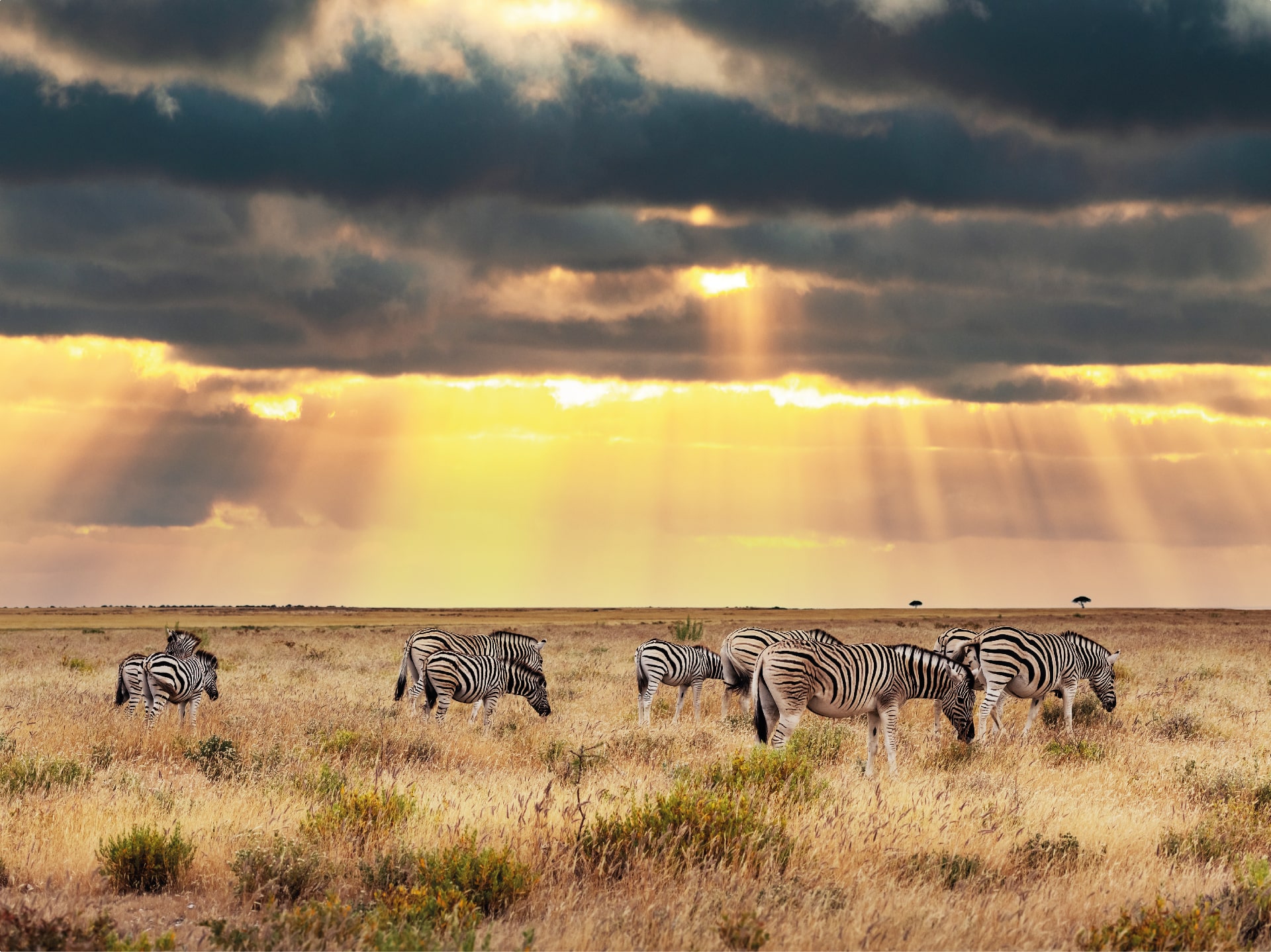
By contrast, Kenya’s Masai Mara National Reserve covers just 1,510 square kilometres — roughly one-tenth the size of the Serengeti. Consequently, wildlife is far more concentrated. Animals have less space to spread out, which means more sightings per hour of game driving. Furthermore, the Mara’s rolling grasslands, scattered acacia trees, and the winding Mara River cutting through the centre create a classic East African savannah landscape that is immediately stunning.
For travelers on a tight schedule, this concentration is a genuine advantage. Nevertheless, that same density has a trade-off. During peak season — particularly in August and September when the wildebeest river crossings are at their height — it is common to see fifteen or more Land Cruisers surrounding a single predator sighting. As a result, the solitude of the Serengeti is difficult to replicate inside the Masai Mara’s main reserve, though the private conservancies surrounding it come close.
Size verdict: Choose the Serengeti if wilderness scale and genuine solitude are your priority. Choose the Masai Mara if you want concentrated wildlife encounters on a shorter trip.
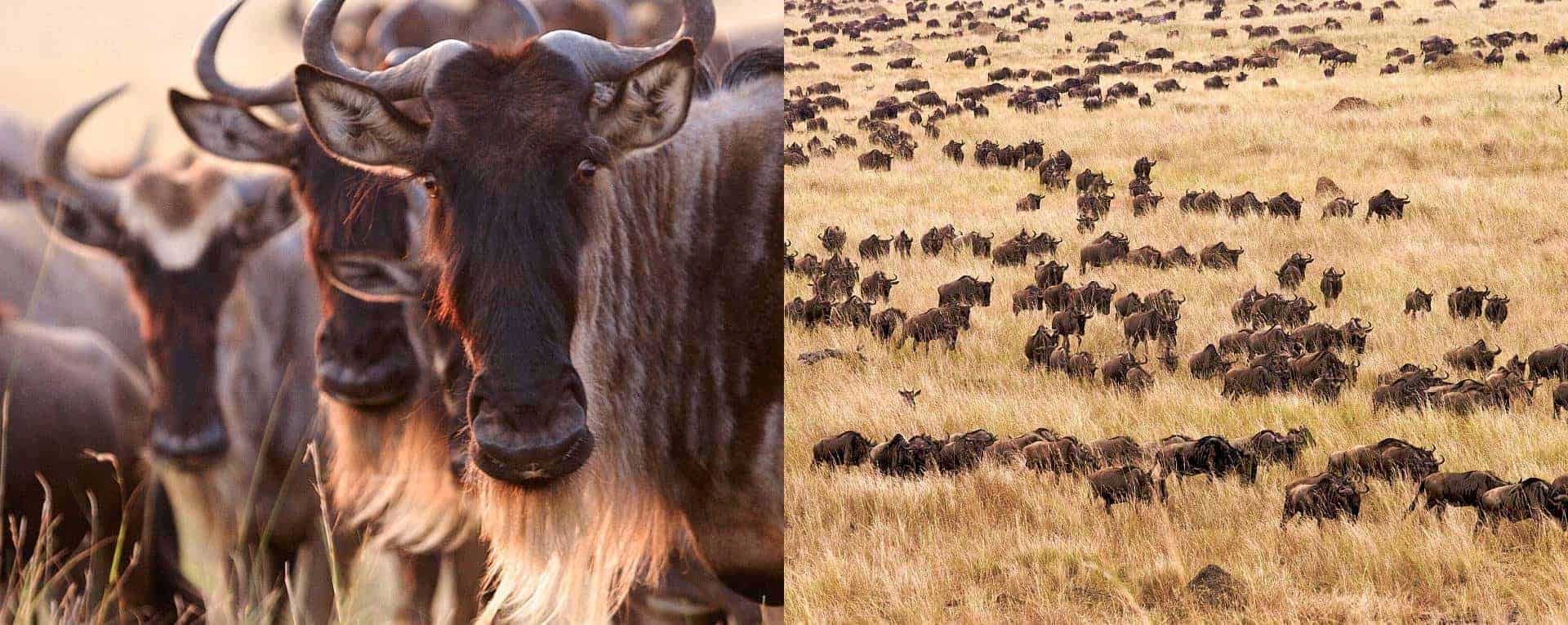
The Great Wildebeest Migration is the defining event of any East African safari. Over 1.5 million wildebeest, alongside hundreds of thousands of zebra and Thomson’s gazelle, travel in a continuous clockwise loop through the Serengeti-Mara ecosystem in search of fresh grass and water. Importantly, understanding when the migration is where will determine which park you should book — and when.
The single most overlooked fact about the migration is this: the herds spend nine months of the year inside Tanzania’s Serengeti. The Masai Mara receives the herds for approximately three months between July and October. Consequently, if flexibility in your travel dates exists, the Serengeti offers a far wider window for witnessing this extraordinary natural event.
| Months | Migration Location | Key Wildlife Event |
|---|---|---|
| January to March | Southern Serengeti — Ndutu | Calving season — up to 8,000 births per day, intense predator action |
| April to June | Central and Western Serengeti | Northward trek, Grumeti River crossings, green season photography |
| July to October | Northern Serengeti and Masai Mara | Mara River crossings — peak season across both parks |
| November to December | Eastern Serengeti | Return south, uncrowded conditions, calving season building |
Each year between January and March, the wildebeest herds gather on the short-grass plains around the Ndutu area in Tanzania’s southern Serengeti. This is the calving season, and the sheer scale is extraordinary: up to 8,000 wildebeest calves are born every single day during peak February. As a direct result, the southern Serengeti becomes one of the highest-density predator feeding grounds anywhere on the African continent. Lions, cheetahs, leopards, hyenas, and wild dogs converge on the area in numbers rarely seen elsewhere.
Newborn wildebeest calves can run within minutes of birth. Even so, predators are everywhere and the survival drama plays out continuously across the plains. January to March in the Serengeti is arguably the most underrated time to visit East Africa — and with significantly fewer tourists than peak crossing season, the experience is even more rewarding.
Between April and June, the wildebeest herds begin their northward journey through the central and western Serengeti. April and May coincide with the long rains, which means considerably fewer tourists and noticeably lower lodge prices compared to peak season. In addition, the lush green landscapes produce some of the most spectacular safari photography of the year. The Grumeti River crossings in the western corridor take place during this period — less famous than the Mara crossings, yet equally thrilling and far less crowded.
By July, the leading edge of the migration crosses the Tanzania border into Kenya’s Masai Mara. The herds remain through September and into October before moving back south. The Mara River crossings are among the most cinematically dramatic wildlife spectacles in the world. Thousands of wildebeest mass on the riverbanks, churning up dust and bellowing before finally launching themselves into the fast current. Given that the Mara River contains enormous Nile crocodiles reaching five metres in length, every crossing is genuinely life-or-death. Above all, this is the event that draws most first-time Africa safari travelers to the Masai Mara.
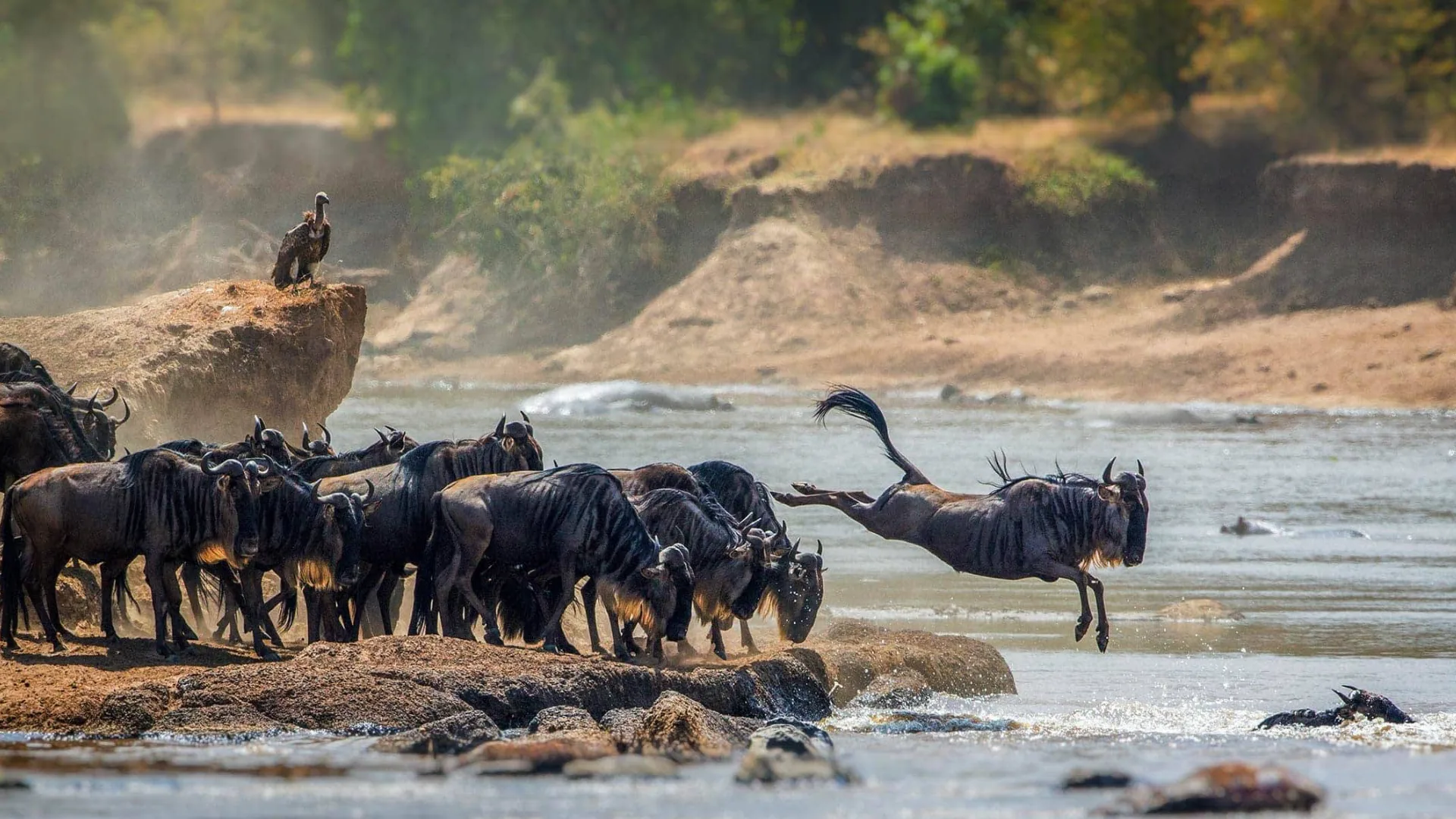
August and September represent the absolute peak of river crossing season. It is worth noting, however, that the northern Serengeti — just across the Tanzania border — hosts these exact same crossings with significantly fewer safari vehicles in attendance.
By November, the rains return and the wildebeest herds begin their journey back southward through the Serengeti. December sees the animals returning to the Ndutu plains in Tanzania, completing the annual cycle. The Serengeti during this period is beautiful, uncrowded, and still rich in resident wildlife — even as the migration herds reposition for the calving season ahead.
Migration verdict: If witnessing the Mara River crossings is your sole priority and you are traveling in August or September, the Masai Mara is the obvious answer. However, for year-round Great Migration access, fewer crowds at every phase, and the extraordinary calving season, the Serengeti in Tanzania wins by a clear margin.
Both the Masai Mara and the Serengeti deliver outstanding Big Five safari experiences — lion, leopard, elephant, Cape buffalo, and rhino. Nevertheless, the way you encounter Africa’s iconic wildlife differs considerably between these two destinations.
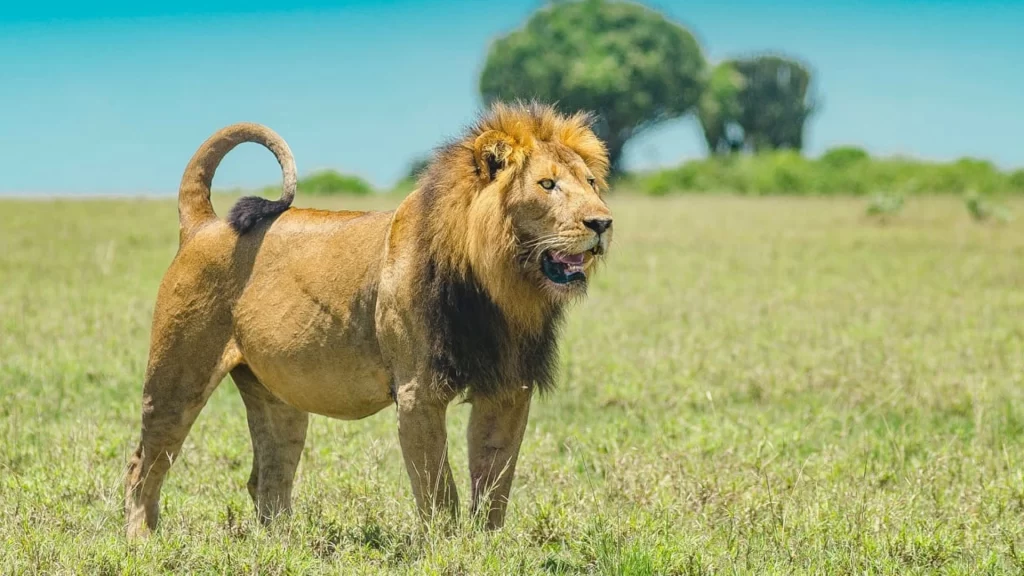
The Masai Mara is particularly celebrated for its lion prides. Because the reserve is compact and the grasslands are open, lions are spotted quickly and frequently on almost every game drive. The combined Serengeti-Mara ecosystem supports over 3,000 lions in total. Inside Tanzania’s Serengeti, lions are equally abundant across a far larger area — which means encounters feel more earned. Specifically, the central Seronera valley and rocky kopje outcrops of the northern Serengeti produce some of the most outstanding lion sightings in Africa.
For leopard sightings, the Serengeti holds a meaningful edge. The granite kopje outcrops scattered across Tanzania’s Serengeti landscape provide ideal leopard habitat, and cats are regularly spotted draped across the branches of acacia or sausage trees near the Seronera area. Furthermore, the kopjes create a natural photography backdrop that is difficult to match. In the Masai Mara, leopards are present but the more open terrain pushes them into riverine forest, requiring more focused tracking to locate.
When it comes to cheetah sightings, the Masai Mara is one of the finest locations on earth. The wide, open grasslands provide exceptional sightlines and the Mara’s cheetah families — often with cubs — are highly habituated to safari vehicles, allowing extended, undisturbed observation. Similarly, Tanzania’s Serengeti southern plains are outstanding for cheetahs during the calving season, when prey density is at its annual peak.

Both parks support large elephant populations. Tanzania’s Serengeti elephants are commonly seen in large herds across the east and north of the park. Rhinos, however, are the most challenging of the Big Five to spot in either park as a standalone destination. Inside Kenya, the western Mara Triangle area offers realistic rhino sighting chances. In Tanzania, the Ngorongoro Crater is the go-to destination for reliable black rhino sightings — and it is routinely combined with a Serengeti safari on our northern circuit itineraries.
For birdwatching, the Serengeti holds a decisive advantage. Its sheer size and diverse micro-habitats — from short-grass southern plains to riverine forests, rocky kopjes, and seasonal western swamps — support over 500 recorded bird species in Tanzania. The western corridor’s Grumeti River system also sustains enormous hippo populations year-round, an additional wildlife highlight that many safari travelers overlook.
One of the most compelling reasons to choose a Tanzania safari over the Masai Mara alone is the quality of the multi-park circuit available. When you visit the Serengeti, you are entering the finest collection of wildlife areas in the world within a single connected itinerary. The Ngorongoro Crater — a breathtaking volcanic caldera in Tanzania — hosts over 30,000 animals within its walls, including some of Africa’s last remaining black rhinos and one of the densest lion populations anywhere on the continent. Tarangire National Park, famous for its massive elephant herds and prehistoric baobab trees, and Lake Manyara National Park, known for tree-climbing lions and thousands of flamingos, flow seamlessly from the Serengeti in a single well-designed Tanzania safari circuit.
 The floor of Tanzania’s Ngorongoro Crater — a self-contained ecosystem with over 30,000 animals, including rare black rhinos. No Tanzania safari itinerary should skip it.
The rules governing safari conduct directly impact your wildlife experience — as well as the long-term health of the ecosystems you are visiting.
Tanzania enforces strict conservation regulations throughout the Serengeti National Park. Off-road driving is prohibited in most areas, which requires guides to be expert trackers operating within designated routes. Although some visitors initially see this as a restriction, the real-world effect is significant. Animals are not hemmed in by vehicles encroaching on their territory, the grassland ecosystem remains intact, and wildlife interactions feel genuinely natural and unhurried. When you find a pride of lions in the Serengeti, you observe them living freely — not performing for a ring of vehicles.
The Masai Mara, by contrast, operates under different rules — particularly inside its surrounding private conservancies. Off-road driving is permitted, allowing vehicles to pull alongside wildlife for close observation. In the hands of responsible, ethical operators this produces extraordinary sightings. Nevertheless, during peak migration season, a single major sighting can attract vehicles from across the reserve until the scene becomes genuinely stressful for the animals. As a result, the Serengeti’s stricter conservation approach creates a more respectful dynamic that many experienced African safari travelers come to deeply value.
Cost is one of the most significant practical differences between these two African safari destinations, and the Masai Mara is consistently the more affordable option.
Tanzania’s Serengeti enforces both a daily park entrance fee and an additional concession fee for accommodation within the park boundaries. These fees are among the highest in Africa and are deliberately structured to limit visitor numbers while funding conservation. Kenya’s Masai Mara charges a daily conservation fee but the overall fee structure is notably lower — especially when budget and mid-range accommodation options outside the park gate are factored in.
The Serengeti is predominantly geared toward premium and luxury accommodation. The most sought-after properties are mobile luxury tented camps that follow the migration herds twice yearly, repositioning the entire camp to keep guests in the heart of the Great Migration action. These camps deliver five-star amenities — fine dining under open skies, en-suite hot showers, and expert guiding — while remaining embedded in genuine Tanzanian wilderness. You fall asleep to lions roaring and wake to elephants moving past camp in the pre-dawn dark.
The Masai Mara, on the other hand, offers a far wider range of accommodation at different price points. Budget tented camps and solid mid-range lodges cluster just outside the reserve boundaries. Inside the park and within the private conservancies, options range from comfortable mid-range properties right through to world-class exclusive lodges. As a result, the Mara is genuinely accessible to a wider range of safari budgets.
The Masai Mara is straightforward to reach. From Nairobi’s Wilson Airport, multiple scheduled light aircraft services land at the Mara’s airstrips in approximately 45 minutes. Alternatively, the scenic road drive through the Great Rift Valley takes five to six hours. Reaching the Serengeti in Tanzania requires more planning: most travelers fly into Kilimanjaro International Airport, transfer to Arusha, and then take a further internal flight into the park. If you are building the recommended northern Tanzania circuit — which we strongly advise — plan for a minimum of seven to ten days.
Cost verdict: A comparable Masai Mara safari typically costs 20 to 35 percent less than an equivalent Serengeti safari. For budget-conscious travelers, the Masai Mara is the clear choice. For those willing to invest in total wilderness immersion, the Serengeti’s premium pricing delivers an experience that is genuinely exclusive and difficult to replicate anywhere else in Africa.
During the peak migration season, the Masai Mara attracts more visitors per square kilometre than any comparable African safari destination. At major sightings — a kill in progress, cheetahs with cubs, a river crossing underway — fifteen to twenty vehicles gathering in one place is not unusual. Reputable operators work hard to minimise the convoy effect, but peak season crowd management in the Mara is a real consideration for any traveler prioritising solitude.
The Serengeti, by contrast, absorbs visitors across such a vast Tanzania landscape that genuine solitude remains available even during the busiest months. In particular, the northern Serengeti near the Lamai and Kogatende area delivers extraordinary Great Migration game viewing with a fraction of the Masai Mara’s vehicle density.
One of the Masai Mara’s most significant and underappreciated strengths is its network of private conservancies. Areas including Olare Motorogi, Naboisho, Mara North, and Ol Kinyei are managed privately in partnership with local Maasai communities under strict low-density tourism rules. Specifically, conservancy camps limit vehicles at any sighting to a maximum of three. Off-road driving is permitted. Night drives and guided bush walks — both prohibited inside the national reserve — are standard inclusions at virtually every conservancy camp.
For travelers who want the wildlife concentration of the Masai Mara without the vehicle congestion of peak season, booking into a private conservancy is the definitive solution and, in our view, produces the best overall safari experience Kenya has to offer.
Inside Tanzania’s Serengeti National Park, night drives are not permitted. Consequently, the after-dark wildlife drama — lions hunting in darkness, civets and genets moving silently through the grass, hyenas working a carcass — is unavailable on a standard Serengeti safari. Some private concessions adjacent to the Serengeti do allow night drives, but they require specific operators and pre-arranged bookings. In the Masai Mara’s private conservancies, by contrast, night drives and guided bush walks are universally offered as standard inclusions. Therefore, if after-dark safari experiences are important to you, the Mara conservancy ecosystem holds a clear and decisive advantage.
Family safaris have specific requirements that shift the balance between these two African safari destinations considerably.
For families traveling with children under twelve, the Masai Mara holds a clear advantage. First, the short flight from Nairobi eliminates the exhausting multi-leg journey required to reach the Serengeti. Second, the Mara’s high wildlife density means children spot action quickly and remain engaged without enduring long, quiet drives across open Tanzania plains. Moreover, family-friendly conservancy camps around the Mara are purpose-built for younger travelers — with spacious family tents, child-appropriate menus, and guides experienced at making the experience educational and genuinely exciting. Cultural visits to Maasai villages are, without exception, the highlight most children remember long after returning home.
The Serengeti in Tanzania is a better fit for families with older children and teenagers. These are young travelers with the patience for longer game drives and the maturity to appreciate the scale and meaning of a vast African wilderness.
Yes — and for travelers with the time and budget, combining both parks creates one of the great safari experiences anywhere in the world. A typical combined Kenya and Tanzania safari itinerary runs between 10 and 14 days.
The Kenya-first approach involves flying into Nairobi, spending three to four nights in the Masai Mara or a private conservancy, returning to Nairobi, then connecting to Kilimanjaro International Airport and spending four to five nights across the Serengeti and Ngorongoro Crater. The Tanzania-first approach simply reverses the sequence. Both work well depending on your travel dates and which phase of the Great Migration you want to prioritise.
At WeGuide African Safaris, we design combined Kenya and Tanzania itineraries built around your specific travel dates, interests, and budget. The migration calendar is always the critical factor in our planning — we position you where the action is, not where the standard package sends everyone else.
The Masai Mara delivers outstanding African safari experiences year-round. That said, the absolute peak runs from August through September during the height of the Mara River crossings. July is excellent as the Great Migration herds begin arriving in Kenya. October remains strong before the wildebeest head back south into Tanzania. During the short rains in November and the long rains from March to May, prices fall 30 to 50 percent below peak season rates and vehicle numbers drop dramatically. Resident wildlife — lions, leopards, elephants, hippos, giraffes, and cheetahs — remains exceptional in the Masai Mara every month of the year, making green season one of the most underrated safari windows available.
Tanzania’s Serengeti genuinely has no bad season because the Great Migration is always somewhere within the park. January to March is ideal for calving season action and extraordinary predator density in the southern Serengeti. April and May offer green season conditions, lower prices, and the western Grumeti River crossings. June through October is prime time for the northern Serengeti as the herds push toward Kenya. November and December provide uncrowded, beautiful conditions as the return migration builds toward calving season once again.
There is no single superior park. There is only the park that best matches your specific travel priorities, timeline, and budget. Here is our honest, experience-based recommendation.
Finally, if you have ten or more days and want the most complete East African safari experience available, combine both. See our 13-day combined Kenya and Tanzania safari — it is the ultimate way to experience the full Serengeti-Mara ecosystem.
The Masai Mara is a compact wildlife reserve in Kenya covering 1,510 square kilometres. The Serengeti is a vast national park in Tanzania covering 14,760 square kilometres — nearly ten times larger. While the Mara offers concentrated wildlife and easy Nairobi access at lower cost, the Serengeti delivers a more remote wilderness experience with year-round Great Migration access and a world-class multi-park Tanzania circuit. Both are outstanding African safari destinations suited to different traveler priorities.
The Serengeti in Tanzania hosts the Great Wildebeest Migration for nine months of the year across multiple distinct phases, including the calving season from January to March and the famous Mara River crossings from July to October. The Masai Mara in Kenya hosts the migration for approximately three months. For the most flexibility and year-round migration access, the Serengeti is the stronger choice. For the Mara River crossings specifically, the Masai Mara in August or September is ideal.
Yes. A comparable African safari in the Masai Mara typically costs 20 to 35 percent less than the same quality experience in the Serengeti. Tanzania’s higher park entrance fees, additional concession fees, more expensive internal flights, and predominantly luxury accommodation structure make the Serengeti a significantly more expensive destination overall. The Masai Mara offers more accommodation options at budget and mid-range price points.
Most first-time African safari visitors benefit most from the Masai Mara. The straightforward Nairobi access, high wildlife density, shorter trip commitment, and wider accommodation price range make it an outstanding introduction to East African safari. Experienced safari travelers often gravitate toward the Serengeti’s vast wilderness scale, solitude, and the richness of the full northern Tanzania circuit including Ngorongoro Crater, Tarangire, and Lake Manyara.
Yes. Both parks offer Big Five safari experiences covering lion, leopard, elephant, Cape buffalo, and rhino. Dedicated rhino viewing is best at the Mara Triangle in Kenya or Tanzania’s Ngorongoro Crater, both of which are routinely combined with their respective main park safaris on our itineraries.
A minimum of three to four nights is recommended for the Masai Mara to experience a full range of game drives. The Serengeti benefits from at least four to five nights, and ideally five to seven nights when combined with Tanzania’s Ngorongoro Crater and other northern Tanzania parks such as Tarangire and Lake Manyara.
Yes. Both parks are part of the greater Serengeti-Mara ecosystem. There is no fence on the Kenya-Tanzania border between them, and the wildebeest herds of the Great Migration move freely across it each year. This shared, unfenced wildlife corridor — covering over 30,000 square kilometres in total — is one of the last functioning examples of its kind anywhere on earth.
Both the Masai Mara and the Serengeti rank among the best African safari destinations in the world. The right choice depends entirely on your priorities. The Masai Mara in Kenya is ideal for first-time travelers, families with young children, shorter trips, and budget-conscious safaris. The Serengeti in Tanzania is the better choice for wilderness scale, year-round Great Migration access, luxury mobile camps, and the full northern Tanzania multi-park experience. For the ultimate African safari, combine both.
Based in East Africa, we have guided hundreds of travelers through both the Masai Mara and the Serengeti. Years of firsthand experience have given us deep knowledge of these iconic ecosystems—from camps that deliver exceptional value across every budget to the precise timing of each stage of the Great Migration.
Our expertise also extends to the conservancies that offer the Mara’s extraordinary wildlife density with far fewer vehicles, as well as the remote Serengeti regions that remain wild and uncrowded long after peak season.
Rather than selling pre-built packages, we craft tailor-made safari experiences designed around your interests, pace, and travel style.