
Wondering when to see the Great Migration? It is one of nature’s most extraordinary spectacles — and knowing the right time to go makes all the difference.
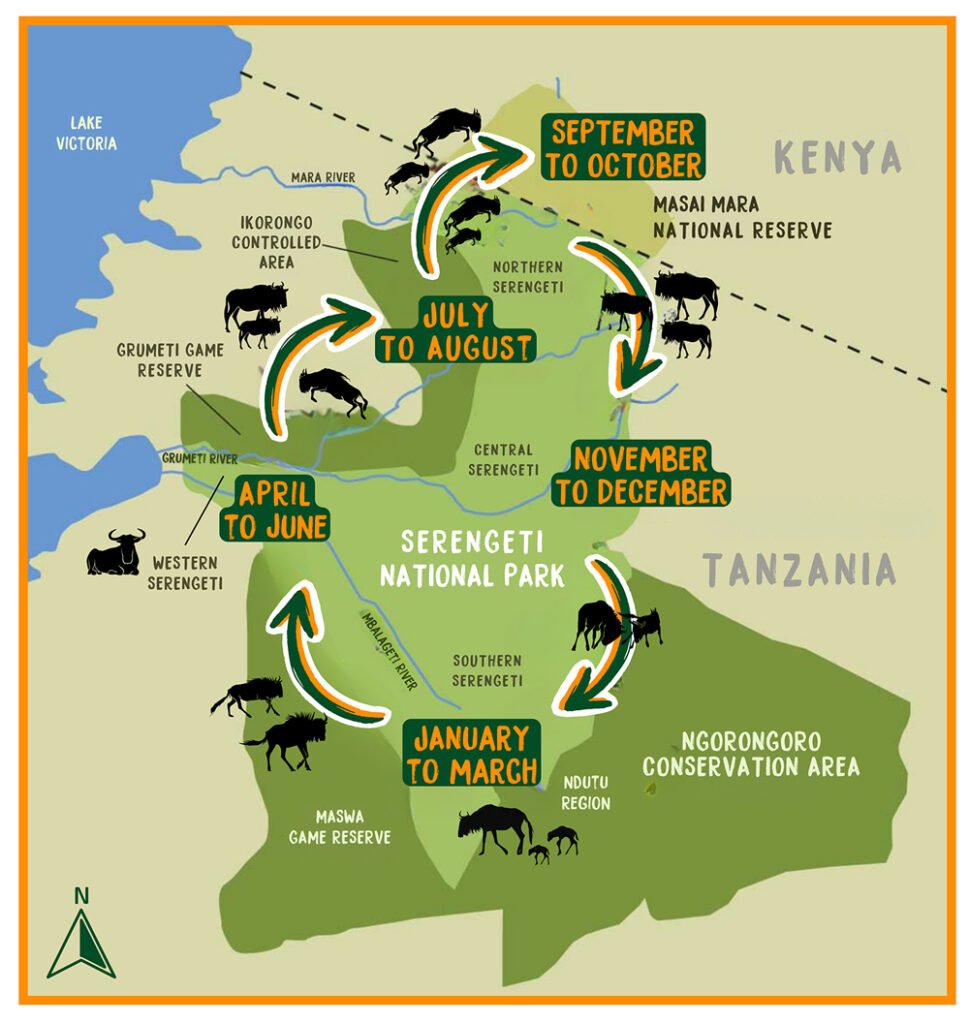
The Great Migration is the largest overland wildlife movement on Earth. Every year, roughly 1.5 million wildebeest — joined by hundreds of thousands of zebra and antelope — trek in a continuous circle between Tanzania’s Serengeti National Park and Kenya’s Masai Mara National Reserve. Unlike a race with a finish line, this is an eternal, year-round cycle with no beginning and no end, driven entirely by rainfall and the search for fresh grass.
Ultimately, when to see the Great Migration depends on what you want to witness. Are you drawn to the drama of Mara River crossings? The tenderness of wildebeest calving season? Or simply the sight of endless herds stretching to the horizon?
This guide breaks it all down — season by season and month by month — so you can plan the Great Migration safari that is perfectly right for you.
The Four Seasons of the Great Migration
Where: Southern Serengeti, Ndutu Plains, Ngorongoro Conservation Area
If you travel between January and March, you are heading straight to one of the most emotional wildlife spectacles on the planet — the wildebeest calving season.
The vast herds gather on the short grass plains around Ndutu and the Ngorongoro Conservation Area, where volcanic ash beneath the soil enriches the grasses with phosphorus and magnesium. As a result, these nutrient-dense plains are essential for pregnant females in the final weeks before birth.
February is the peak of the calving season. In a two- to three-week window, over 500,000 calves are born — roughly 8,000 per day. Consequently, the sheer concentration of vulnerable newborns draws an extraordinary gathering of predators: lions, cheetahs, leopards, hyenas, and wild dogs all descend for what becomes an intense, raw, and unforgettable display of the natural food chain in action.
Month-by-month breakdown:
Who should go: Photographers, families, and anyone who finds the birth of life as moving as the drama of the kill. The light in February and March is also exceptional for wildlife photography.
Where: Central Serengeti, Moru Kopjes, Western Corridor, Grumeti Reserve
As the long rains arrive and the southern plains begin to dry, the herds start their slow, magnificent march northward. This is the Great Migration at its most majestic — columns of wildebeest stretching several kilometres, flooding across the landscape in an unstoppable tide.
April sees the herds moving through the central Serengeti at a leisurely pace, grazing on medium-to-tall Pennisetum and Themeda grasses as they go. By May, massive columns can be seen flooding the Moru Kopjes, and the sight of hundreds of thousands of animals moving in unison is something that stays with you for the rest of your life.
June marks the beginning of the rut — mating season — when male wildebeest engage in fierce, frenzied battles for females, adding a theatrical layer of drama and noise to the migration. Furthermore, by the second half of June, large concentrations build up on the southern banks of the Grumeti River in the Western Corridor, bracing for their first dangerous river crossing of the year.
Who should go: Travellers who want to see the scale of the migration — vast, rolling herds — without the peak-season crowds of July and August. Green season rates and lush landscapes make this a photographer’s secret weapon.
Where: Northern Serengeti (Kogatende, Lamai Wedge), Masai Mara
This is what most people picture when they imagine the Great Migration safari — the iconic, heart-stopping Mara River crossings. Tens of thousands of wildebeest plunge into crocodile-infested waters, driven by instinct and pulled back by fear, until the pressure of the herd behind them finally tips the balance. The result is chaotic, primal, and utterly breathtaking.
River crossings typically begin in July and continue through October. However, their timing is never guaranteed — these are wild animals responding to rainfall patterns, not a schedule.
Who should go: Anyone who wants maximum drama. July and August offer the most reliable sightings of large-scale crossings. If witnessing the Mara River crossings is your primary goal, build your safari around these months.
Where: Central to Southern Serengeti, Ndutu
By December, the Great Migration is dispersed across a broad swathe of the Serengeti — from as far north as Lobo down to the southern reaches of Ndutu. Fortunately, the rains finally catch up with the still-moving herds, and the animals return to the nourishing grasses of the south: Pennisetum, Sporobolus, Andropogon, Cynodon, and Themeda — the same species that sustained them during calving the previous year.
The circle closes quietly. Then, inevitably, it begins again.
| Month | Location | Highlight |
|---|---|---|
| January | Southern Serengeti, Ndutu | Herds gathering; early calving begins |
| February | Ndutu, Kusini Plains | Peak calving — 500,000+ calves born |
| March | Ndutu–Kusini, Maswa | End of calving; herds stationary |
| April | Central Serengeti | Trek north begins; last big southern herds |
| May | Moru Kopjes, Central Serengeti | Massive moving columns; rut approaches |
| June | Western Corridor, Grumeti | Rutting season; first Grumeti crossings |
| July | Northern Serengeti, Kogatende | First Mara River crossings begin |
| August | Lamai Wedge, Northern Serengeti | Peak river crossings; dry season |
| September | Masai Mara, Kenya | Herds at northernmost point |
| October | Mara River, Lobo Valley | Return crossings south into Tanzania |
| November | Lobo, Central Serengeti | Short rains drive herds south |
| December | Central to Southern Serengeti | Herds disperse; cycle prepares to restart |
Knowing when to see the Great Migration is the first step in planning your safari — and the honest answer is that there is no single “best” time. It all depends on what you want to experience. For calving season, travel in January–March. For Mara River crossings, July–October is your window. Alternatively, for vast herds on the move through spectacular scenery, April–June offers extraordinary value with far fewer crowds.
The most famous crossings take place at the Mara River and Talek River, both of which flow between the northern Serengeti and the Masai Mara. In particular, camps in the Kogatende area and the Lamai Wedge offer excellent positioning for these sightings.
Yes — and this is one of the migration’s great advantages. Because the migration is a continuous annual cycle, there is always something remarkable to witness in the Serengeti ecosystem. As a result, Asilia’s camps are positioned all along the migration route to ensure guests have the best possible opportunity for up-close encounters, regardless of when they travel.
Broadly, yes — historical patterns give a reliable framework for planning. However, rainfall is becoming increasingly unpredictable due to climate change, which means the herds can shift their timing and location. Therefore, working with an experienced safari operator who monitors conditions in real time is essential for the best results.
The concentration of prey animals naturally draws an extraordinary density of predators. Cheetahs, lions, leopards, hyenas, and wild dogs are all commonly sighted during the migration. Beyond that, the Serengeti ecosystem is also home to elephants, giraffes, buffalo, and over 500 species of birds, making it one of the finest wildlife destinations on Earth regardless of where the herds are at any given moment.
Book early. The best camps along the migration route — particularly in the northern Serengeti during July–October — fill up 12 to 18 months in advance. Consequently, early booking is not just advisable; it is essential.
Allow at least five to seven nights. River crossings in particular are unpredictable. In general, the longer you stay in the right area, the better your chances of witnessing a major crossing event.
Work with a specialist operator. The migration route spans two countries and multiple ecosystems. An experienced operator will not only track real-time herd movements but also position you in exactly the right place at the right time.
Pack for the season. The green season (November–April) brings afternoon thunderstorms but also lush landscapes, newborn animals, and considerably fewer tourists. By contrast, the dry season (June–October) brings dust but exceptional wildlife density and the famous river crossings.
Combine regions for the full experience. A well-planned itinerary might, for example, take in Ndutu for calving in February, the Western Corridor for the Grumeti crossing in June, and then the northern Serengeti or Masai Mara for the Mara River crossings in August. Without doubt, the full circuit is unforgettable.
Whether you witness the tender chaos of calving season in the Ndutu Plains, the thundering columns of the trek north through the Moru Kopjes, or the terrifying beauty of a Mara River crossing in August — the Great Migration will change the way you see the natural world.
Far more than just a wildlife event, this is the heartbeat of an entire ecosystem, playing out in real time, every year, without pause.
Plan your Great Migration safari with care, travel with patience, and prepare to be humbled.
Ready to start planning? Download our complete Great Migration Safari eBook for a detailed map, camp recommendations, and expert insider tips for every month of the year.